


Table of Contents
- The Long Staple Cotton Benefits That Make Fabric Last
- How to Identify High Quality Cotton Before You Buy
- How to Care for Premium Cotton Clothing So It Keeps Its Shape
- Why Premium Cotton Lasts Longer: Fiber Structure and Spinning
- Weave Density, Pilling Resistance, and Everyday Durability
- Cost Per Wear: The Real Math Behind Premium Cotton
- Common Mistakes That Shorten Cotton's Life
- Conclusion
- Frequently Asked Questions
Last Updated: September 20, 2026
The Long Staple Cotton Benefits That Make Fabric Last
Premium cotton lasts longer because its fibers are longer, stronger, and less likely to break down with repeated washing and wear. According to Cotton Incorporated's Global Lifestyle Monitor, 67% of consumers rate cotton clothing as the most comfortable option, and 59% rate it as the best quality fiber. That quality shows up as durability.
Here's why that matters for your wallet:
- Longer fibers mean fewer exposed ends that tangle and pill
- Stronger yarns survive more wash cycles without thinning
- Fewer fiber breaks mean the fabric keeps its structure
How to Identify High Quality Cotton Before You Buy
You can spot high quality cotton by checking three things: fiber length, fabric weight, and construction details.
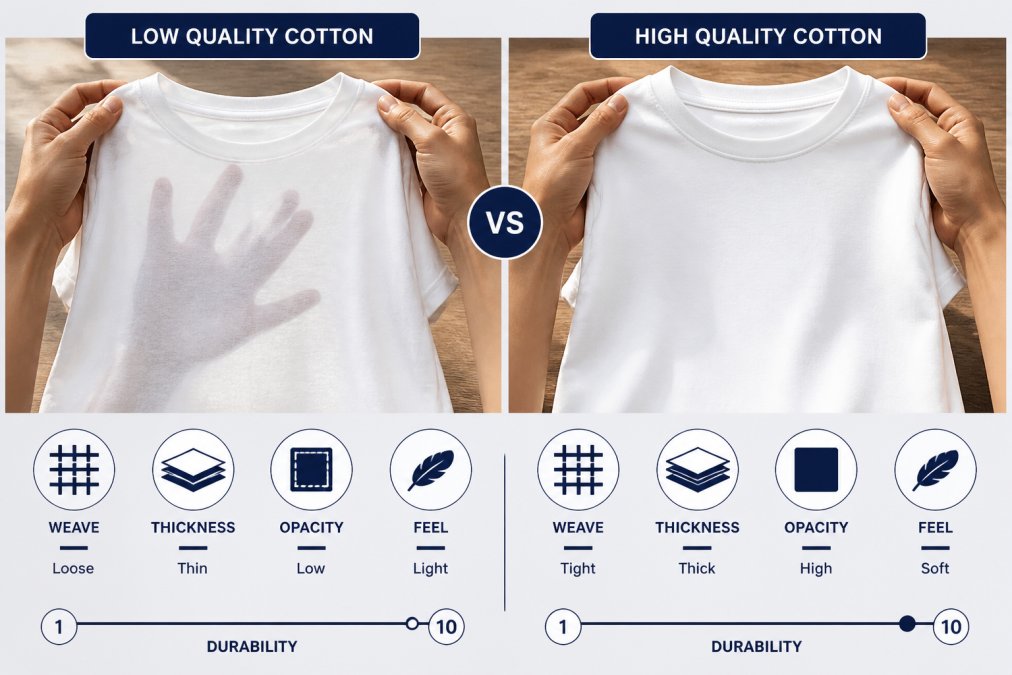
- Check for fiber length terms on the label
- Feel the fabric weight between your fingers
- Look for reinforced seams and clean stitching
- Hold it to light: thin, see-through fabric won't last
How to Care for Premium Cotton Clothing So It Keeps Its Shape
Most articles tell you to wash cold and dry low. That advice is correct, but it skips the storage and rotation habits that quietly decide whether a premium tee lasts three years or ten. Here is the full protocol.
Why cold water actually protects the fiber
Cotton is cellulose. Heat plus agitation accelerates hydrolysis of the cellulose chains and mechanical abrasion of the fiber surface. Hot water swells the fiber, loosens the yarn twist, and lets short fibers migrate to the surface where they pill. Cold water (a maximum of 90°F) cleans everyday soil and body oils just as effectively while keeping the yarn structure tight.
The wash cycle
- Turn garments inside out. This puts the abrasion on the interior face, not the visible surface, and protects any print or garment-dye finish.
- Machine wash cold, gentle or normal cycle. Max 90°F. Use a mesh bag for lightweight knits.
- Use half the recommended detergent. Modern detergents are concentrated; excess surfactant leaves residue that traps soil and stiffens fiber over time.
- Skip bleach and fabric softener. Bleach oxidizes cellulose and permanently weakens the fiber. Fabric softener coats fibers with a waxy film that reduces absorbency and breathability, the exact properties you paid for.
- Wash with similar weights and colors. Heavy denim abrades lightweight jersey in the drum. Sort by weight, not just color.
Drying and heat
Tumble dry on low, or line dry. High heat is the fastest way to shrink and weaken cotton because it drives residual moisture out of the fiber lumen and contracts the cellulose chains. If you must use a dryer, pull items out slightly damp, over-drying is cumulative damage that shows up as thinning at the elbows and collar months later.
Storage and stain response
- Store fully dry. Mildew and mold digest cellulose. Damp storage is a fiber-level attack, not just a smell problem.
- Fold knits; hang wovens. Hanging a heavy knit stretches the shoulders and distorts the tubular structure.
- Treat stains immediately. Blot, don't rub, with cold water. Rubbing drives the stain into the yarn and abrades the surface. For oil-based stains, a drop of dish soap before washing is more effective than any specialty stain remover.
- Rotate, don't hoard. A shirt worn once a week lasts far longer than the same shirt worn four times a week, because the fiber gets time to recover its shape between wears.
What about dry cleaning?
Skip it for everyday cotton. The solvents used in dry cleaning are harsh on natural fibers and the pressing heat is aggressive. Reserve dry cleaning for structured garments like suits and coats where the construction demands it. For tees, sweatshirts, and casual knits, cold water and low heat are the entire protocol.
The takeaway on care
Premium cotton's longevity is inherent in the fiber, but it's not unconditional. Cold water, low heat, less detergent, immediate stain response, and rotation are the habits that let a long-staple garment deliver on its promise. The fiber does the heavy lifting; your care routine just has to stop getting in the way.
Rick's Crabs T‑Shirt With Mr.Blunt way →
Why Premium Cotton Lasts Longer: Fiber Structure and Spinning
Fiber structure and spinning methods determine how long cotton fabric lasts. Longer fibers can be twisted tighter during spinning, creating stronger yarns with fewer weak points.
Weave Density, Pilling Resistance, and Everyday Durability
Pilling is the most visible sign of a cotton garment aging, and the clearest place where premium fiber separates from cheap fiber. Weave density, blend composition, and how fibers shed over time also determine how a garment performs in year three, not just year one.
Why pilling happens at the fiber level
Pilling is a three-stage process: a fiber migrates to the fabric surface, tangles with neighboring fibers, and forms a pill that eventually breaks off. Short fibers migrate more easily because less length anchors them inside the yarn. Long-staple cotton resists migration because each fiber is held by more of its own length, fiber physics, not marketing.
Mercerization and tensile strength
Mercerization, treating cotton under tension with a caustic solution, swells the fiber, straightens the cellulose chains, and increases tensile strength. The result resists tearing, holds its shape through washing, and takes dye more deeply, producing the subtle sheen of high-end cotton. Mercerized long-staple cotton delivers both durability and the hand-feel people associate with premium.
The blend problem: why cotton-poly pills faster
When cotton is blended with polyester, the two fibers behave differently under abrasion. Polyester is stronger and doesn't break down as quickly, so it stays on the surface while the cotton around it wears away. The result pills, looks fuzzy, and develops a dull, tired appearance faster than 100% cotton of the same weight. The polyester also traps odors and reduces breathability, lacking cotton's hollow-core moisture transport.
Breathability and moisture management
Cotton fibers have a hollow core, called the lumen, that moves moisture away from the skin and lets it evaporate. That structure stays intact longer when the fibers are long and the yarn is well-spun. Synthetics move moisture through capillary channels that clog with body oils and detergent residue over time, which is why a synthetic shirt often feels clammy after a year while a well-made cotton shirt still breathes.
Everyday durability: what actually fails first
In real wear, cotton garments rarely fail mid-panel. They fail at stress points: the collar, cuffs, underarm, and side seams. That's why construction matters as much as fiber. Double-needle stitching distributes stress across two rows of thread instead of one, and tubular knit construction eliminates side seams entirely. Combine long-staple fiber, a balanced weave, mercerization, and reinforced construction, and the failure mode becomes gradual fading rather than sudden structural collapse.
The durability bottom line
Weave density and pilling resistance are the visible outcomes. The underlying drivers are fiber length, spinning consistency, mercerization, and skipping synthetic blending. Get those right and the garment doesn't just last longer, it looks better while it does.
Rick's Crabs T‑Shirt With Mr.Blunt way →
Cost Per Wear: The Real Math Behind Premium Cotton
A $27 shirt worn 100 times costs $0.27 per wear. A $12 shirt worn 20 times costs $0.60 per wear. The cheaper shirt costs more every time you put it on.
Here's the math:
| Factor | Budget Cotton | Premium Cotton |
|---|---|---|
| Upfront cost | $12 | $27 |
| Washes before breakdown | 20-30 | 100+ |
| Cost per wear | $0.40-$0.60 | $0.27 or less |
| Years of regular wear | 1-2 | 5-10 |
Common Mistakes That Shorten Cotton's Life
Most people damage their cotton clothing without realizing it. These mistakes are easy to fix.
Conclusion
The challenge with building a wardrobe that lasts is knowing which pieces will actually hold up. Most people default to whatever's cheapest, then replace everything in a year. That cycle costs more and delivers less.
Frequently Asked Questions
What is the difference between cotton and premium cotton?
Premium cotton uses longer fibers, often called long-staple, while regular cotton blends shorter fibers. Longer fibers create stronger yarns with fewer exposed ends, so the fabric resists pilling and thinning. Premium cotton also tends to be combed, removing short fibers and impurities. The result is a smoother hand-feel, better moisture management, and a garment that holds its shape through repeated washing.
How does fiber length affect the durability of a garment?
Longer fibers can be twisted more tightly during spinning, which increases tensile strength and reduces the number of fiber ends that work loose. Fewer loose ends mean less pilling and slower surface wear. According to Cotton Incorporated research, 59% of consumers rate cotton as the best quality fiber. In practice, a long-staple cotton shirt keeps its structure after dozens of washes, while a short-staple version may thin at the elbows and collar within months.
Will premium cotton shrink?
Most premium cotton garments are pre-shrunk during manufacturing, so shrinkage is minimal if you follow care instructions. Washing in cold water and tumble drying on low heat preserves the fabric's dimensions. High heat is the main cause of shrinkage because it shocks the fibers and causes them to contract. XEDITION77 tees, for example, are pre-shrunk and carry specific care guidance: machine wash cold, tumble dry low. Following those steps keeps the fit consistent for years.
Is 100% premium cotton worth the higher price point?
It depends on how often you wear the item. A $34 premium cotton tee worn twice a week for two years costs about $0.33 per wear, while a $12 synthetic tee that pills after three months costs more per wear. Research from Cotton Incorporated shows 66% of consumers rate cotton as the softest fiber, and 67% rate it most comfortable. If you value comfort and want a garment that survives regular rotation, the cost-per-wear math favors premium cotton.


