


Table of Contents
- The Real Cost of Fast Fashion vs. Premium Quality
- Understanding Cost-Per-Wear Formula
- How to Identify High-Quality Clothing
- Material Quality and Durability: Where Premium Pricing Justifies Itself
- Brand Markup vs. Actual Quality: Separating Value from Status Signaling
- How to Care for Premium Fabrics
- Finding the Middle-Market Sweet Spot
- Frequently Asked Questions
Last Updated: September 3, 2026
The Real Cost of Fast Fashion vs. Premium Quality
When you buy a $15 shirt that falls apart after five washes, you're spending more per wear than someone who paid $60 for a garment lasting two years. Fast fashion optimizes for speed and volume, cutting corners on fabric quality, seam construction, and finishing details. Premium clothing uses better fabrics, reinforced seams, and attention to details that affect how the garment feels and performs over time.
A fast fashion shirt might use thin, loosely-woven cotton that pills after a few washes, while a premium shirt uses denser fabric with tighter weaving that resists pilling and maintains its shape. Cheap garments use single-stitching prone to unraveling; premium pieces use double or triple-stitching at stress points.
However, premium doesn't automatically mean better. Plenty of expensive brands charge for the label, not the construction. Marketing overhead, celebrity endorsements, and retail markup can inflate prices far beyond what the actual garment quality justifies. The real skill is learning to separate genuine quality from expensive branding.
Understanding Cost-Per-Wear Formula
Cost-per-wear is the most useful lens for evaluating whether premium clothing is worth the price. Divide the total price by the number of times you'll realistically wear it. A $200 jacket worn 100 times costs $2 per wear. A $40 jacket worn 20 times costs $2 per wear.
A $60 premium t-shirt worn twice a week for three years equals 312 wears at $0.19 per wear (peer-reviewed research). A $15 fast fashion shirt worn twice a week for six months equals 52 wears at $0.29 per wear. The premium shirt wins on economics, even though it costs four times more upfront.
Cost-per-wear only works if your estimate is honest. Premium clothing rewards commitment and realistic usage patterns. It punishes impulse purchases and wishful thinking about how often you'll actually wear something. The formula also assumes the garment will actually last, which depends on material quality and construction.
How to Identify High-Quality Clothing
Start with fabric. Feel it and notice the weight and density. Quality fabrics feel substantial with slight resistance when stretched. Cheap fabrics feel thin and flimsy, often translucent when held to light.
Look at the weave. High-quality woven fabrics have tight, even weaving with no visible gaps. Knit fabrics should have consistent stitch density. Loose, uneven stitching signals rushed production.
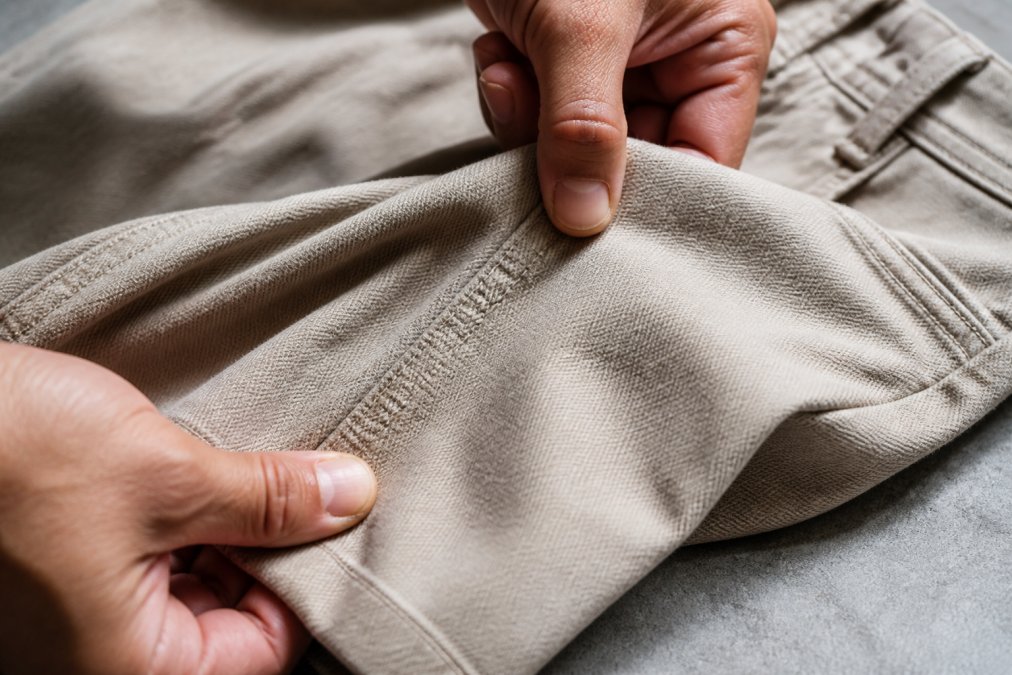
Examine the seams. Premium garments use double or triple-stitching at stress points like armholes and shoulder seams. The stitching is tight and even. Press on a seam with your thumb, quality seams don't separate. Check hems for neat finishing, often with a slight roll that's been topstitched. Quality hems feel smooth and secure.
Look at overall finishing details. Are there loose threads? Are labels sewn in securely? Premium brands obsess over these details. Pay attention to fit, premium pieces are often cut with more precision, and the proportions feel right.
Material Quality and Durability: Where Premium Pricing Justifies Itself
Material quality directly determines how long a garment will last. Natural fibers generally outperform synthetics in durability, comfort, and longevity.
Premium cotton uses long-staple fibers that create stronger, softer fabrics resisting pilling and maintaining color better (usda.gov). Short-staple cotton, used in cheap garments, breaks down faster. Quality wool sweaters can last decades; cheap wool blends lose shape and pill extensively. Linen is one of the most durable fibers available and improves with age.
Synthetic fibers are often used in cheap clothing as cost-cutting rather than quality choice. Low-grade polyester breaks down quickly and loses color. Premium synthetics are engineered for specific performance characteristics.
The difference shows in how garments age. Premium fabrics soften with wear, maintain color, resist pilling, and hold their shape. Cheap fabrics fade quickly, pill extensively, and lose shape. Fabric weight matters too, a heavyweight garment-dyed tee like the Graphic T-Shirt "I Miss the Voices in My Head" from XEDITION77 has enough substance to feel quality and wear like a lived-in piece that improves with time.

Brand Markup vs. Actual Quality: Separating Value from Status Signaling
Much of what you pay for premium clothing has nothing to do with the actual garment. A luxury brand t-shirt might cost $150, but the material might not justify that price. What you're paying for includes marketing and advertising costs, retail markup stacking, design and development, manufacturing location, and status signaling.
The trick is understanding which premium brands charge for actual quality and which charge primarily for marketing. Compare a premium brand against a mid-market brand using the same evaluation criteria, fabric, seams, finishing details, fit. Often you'll find a mid-market brand delivers 80% of the quality at 40% of the price.
XEDITION77 occupies an interesting position, focusing on hand-selected fabrics and timeless refinement without massive marketing overhead. A piece like the Crewneck Sweatshirt "Blunt Way of Life" at $36.55 delivers quality construction and design character without requiring you to justify status signaling. The middle-market sweet spot captures benefits of premium quality without luxury brand markup.

How to Care for Premium Fabrics
Premium clothing requires different care than fast fashion. Wash in cold water, hot water breaks down fibers faster and causes colors to fade. Use a gentle cycle and quality detergent designed for the specific fabric. Avoid bleach and optical brighteners.
Air-drying is almost always better than machine drying. Machine heat damages fibers and causes shrinkage (aatcc.org). Lay garments flat or hang them. A fabric shaver removes pilling without damaging the garment.
Storage matters. Fold heavy items like sweaters rather than hanging them. Use cedar or lavender for moth protection. Keep garments away from direct sunlight. Mending extends the life of premium pieces, a small hole is worth repairing.
The Crewneck Sweatshirt "I Miss The Voices In My Head" at $25.40 demonstrates mid-market value. It's a midweight crewneck with quality construction that will hold up to regular wear if cared for properly. Proper care, cold water washing, air drying, occasional mending, extends the life significantly.

Finding the Middle-Market Sweet Spot
The real answer to whether premium clothing is worth the price depends on where you shop. Ultra-luxury brands are rarely worth the price for most people. Fast fashion is almost never worth the price when you calculate cost-per-wear.
The middle market, brands charging $25-$75 for basics and $40-$150 for statement pieces, is where most people find the best value. You get genuine quality improvements over fast fashion while avoiding the massive markup of luxury brands.
XEDITION77 operates in this space, focusing on hand-selected fabrics and timeless design. The MR.BLUNT WAY OF LIFE HOODIE at $50.33 is priced for genuine quality and design thoughtfulness. You're not paying for celebrity endorsements or luxury retail markup.
Is premium clothing worth the price? Yes, but only if you're buying genuine quality and not just expensive branding. The middle market delivers the best value for most people. XEDITION77 offers this value proposition: hand-selected fabrics, timeless design, and pricing that reflects actual quality rather than marketing overhead. Start with pieces that fit your lifestyle, care for them properly, and you'll find that mid-market premium clothing delivers years of wear and genuine value.
Frequently Asked Questions
What is the cost-per-wear formula and how does it apply to premium clothing?
Cost-per-wear divides the garment's price by the number of times you'll wear it. A $100 shirt worn 100 times costs $1 per wear; a $20 fast-fashion shirt worn 10 times costs $2 per wear. Premium clothing worth the price typically lasts longer and gets worn more frequently, lowering the per-wear cost over time. This shifts the value conversation from initial price to total lifetime value.
Does premium clothing actually last longer than fast fashion?
Yes, when you're buying genuine quality. Premium garments use superior fabric longevity, reinforced seam integrity, and better construction techniques. Fast fashion relies on mass production with thinner fabrics and minimal stitching. However, premium pricing doesn't always guarantee durability, some brands charge more for marketing overhead than actual quality. Examine fabric weight, seam construction, and material composition to verify you're getting durability, not just a brand name.
How much of a premium price goes toward marketing and brand equity rather than actual quality?
Retail markup typically ranges from 50% to 300% depending on the brand. Luxury goods often allocate 20-40% of retail price to marketing, advertising, and brand positioning. Mid-market and premium brands usually dedicate 10-20% to marketing. The remainder covers manufacturing costs, supply chain, retail overhead, and profit. Smaller, lesser-known brands with hand-selected fabrics and quality construction, like XEDITION77's approach, often deliver better value because they spend less on marketing overhead and more on actual garment quality.
What's the difference between a $20 t-shirt and a $40 premium t-shirt?
The primary differences are fabric weight (measured in ounces), fiber composition, and construction. Premium tees typically use 6+ oz cotton versus 4-5 oz in fast fashion, resulting in better drape and longevity. Premium garments have reinforced collar ribbing, double-needle stitching, and higher-quality dyes that resist fading. A heavyweight garment-dyed tee like the 'I Miss the Voices in My Head' at $19.87 offers substantial fabric quality at an accessible price point, delivering better durability than typical mass-produced alternatives at similar price levels.
This article was written using GrandRanker


