


Table of Contents
- Why Durable Men's Casual Wear Is Worth the Investment in 2026
- How to Identify High-Quality Fabric Before You Buy
- Best Clothing for Tradesmen Off Duty: Staples That Hold Up
- What Durable Men's Casual Wear Costs: A Pricing Breakdown
- Men's Clothing Longevity Tips: Care Habits That Add Years
- Repair, Tailoring, and Fit Consistency Across Durable Brands
- Conclusion: Building a Wardrobe That Lasts
- Frequently Asked Questions
Last Updated: September 22, 2026
Why Durable Men's Casual Wear Is Worth the Investment in 2026
Most men don't set out to buy durable mens casual wear because a trend told them to. They buy it because the cheap stuff failed. According to Into The AM's 2026 men's fashion report, 60% of men now say they'll pay a premium for quality clothing, and men aged 25-35 spend 20% more on fewer, higher-quality pieces than they did five years ago.
That shift makes financial sense. Durable mens casual wear is clothing built from heavier fabrics, reinforced stitching, and colorfast dyes so it survives repeated washing without pilling, shrinking, or fading. At XEDITION77, we've watched this play out in what customers actually reorder: heavyweight cotton tees and crewnecks, not fast-fashion filler.
The global menswear market hit $723.4 billion in 2026, according to Fortune Business Insights' menswear market analysis, with fabric quality, fit accuracy, and durability cited as the top purchase drivers.
Below, we'll break down what separates a $30 shirt that lasts three years from a $15 shirt that lasts three months.
How to Identify High-Quality Fabric Before You Buy
High-quality fabric is identified by weight, fiber content, and construction, not by price tag or brand name. A 6.1 oz garment-dyed cotton tee with double-needle stitching will outlast a thinner shirt every time, regardless of what the label charges.
Fabric Weight, Stitching, and What the Label Tells You
Fabric weight is measured in ounces per square yard (oz/yd²). Heavier isn't automatically better, but for everyday wear it resists wear-and-tear far longer than lightweight knits.
Signal |
What to Look For |
Why It Matters |
|---|---|---|
Fabric weight |
6.1 oz+ for tees, 8.0 oz+ for sweatshirts |
Resists thinning and pilling |
Fiber content |
100% ring-spun cotton or cotton-poly blend |
Ring-spun yarns are stronger, softer |
Stitching |
Double-needle seams, tubular knit |
Fewer failure points at stress areas |
Dye method |
Garment-dyed |
Better colorfastness, ages gracefully |
Pre-treatment |
Pre-shrunk |
Prevents shrink resistance issues after washing |
Best Clothing for Tradesmen Off Duty: Staples That Hold Up
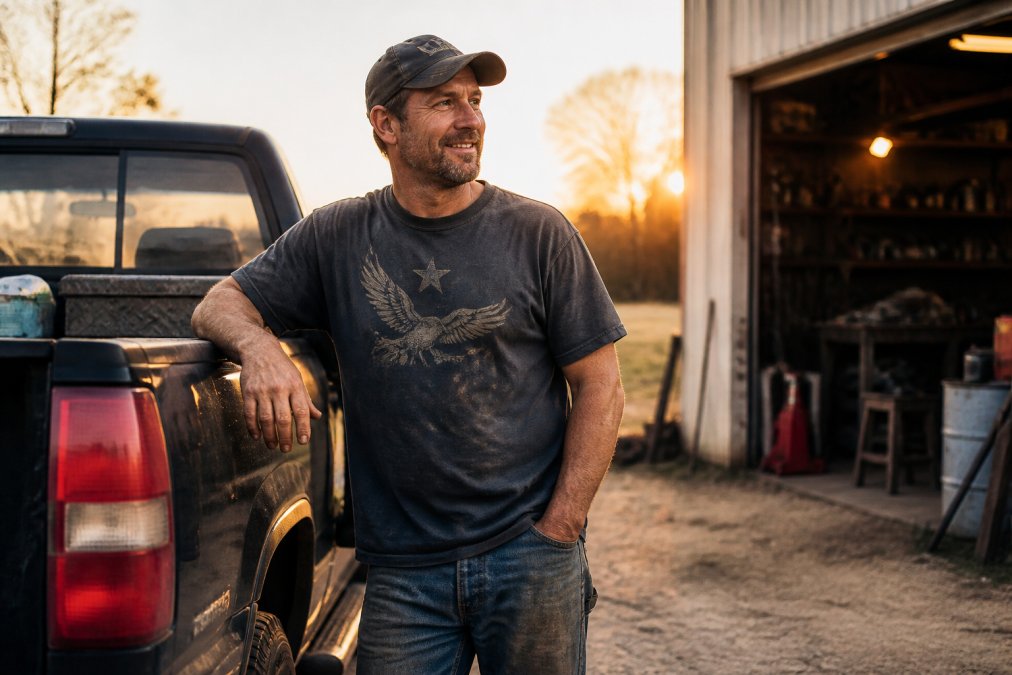
The best clothing for tradesmen off duty balances rugged aesthetic with comfort you can wear past the job site. Three staples do most of the work: heavyweight tees, midweight crewnecks, and denim with real weight to it.
Rick's Crabs T‑Shirt With Mr.Blunt way →
Tees, Crewnecks, and Denim Built for Real Wear
Start with the tee. XEDITION77's Rick's Crabs tee uses 100% ring-spun US cotton at 6.1 oz with double-needle stitching and a tubular knit, so it holds shape through years of cold washes. The garment-dyed finish gives it a broken-in look from day one, which matters if you want vintage character without waiting for it.

Layer a crewneck over it for cooler months.
What Durable Men's Casual Wear Costs: A Pricing Breakdown
Durable mens casual wear sounds high until you calculate cost-per-wear. A $26.58 shirt worn 100 times costs $0.27 per wear. A $12 shirt that pills after 15 washes costs $0.80 per wear and then gets thrown out.
Item |
Price |
Typical Lifespan |
Cost-Per-Wear |
|---|---|---|---|
Heavyweight garment-dyed tee |
$26.58 |
3+ years |
~$0.09 |
Vintage flag tee |
$26.58 |
3+ years |
~$0.09 |
$34.99 |
3+ years |
~$0.12 |
|
Cotton-poly crewneck |
$25.40 |
4+ years |
~$0.06 |
Men's Clothing Longevity Tips: Care Habits That Add Years
Men's clothing longevity tips come down to controlling three forces: heat, mechanical agitation, and chemistry. Heat relaxes cotton fibers and lets them shrink and mat; agitation abrades the yarn surface and creates the fuzz that becomes pilling; bleach and harsh detergents break the cellulose polymer chains that give cotton its tensile strength. Understand those three and the habits below stop being arbitrary rules and start being predictable maintenance.

Why Heat, Agitation, and Chemistry Break Down Fabric
Cotton is a cellulose fiber. Repeated exposure to water above roughly 90°F, combined with the tumbling action of a dryer, causes the fiber surface to fibrillate, tiny fibers lift off the yarn, tangle, and form pills. Ring-spun yarn resists this longer than open-end yarn because its fibers are twisted tighter and aligned, which is one reason a 6.1 oz ring-spun tee outlasts a cheaper knit of the same weight.
A Wash-and-Dry Protocol That Actually Extends Life
- Wash at 30°C / 90°F maximum, inside out, on a normal or gentle cycle
- Use a mild, bleach-free detergent; skip fabric softener, which coats fibers and traps odor
- Tumble dry on low heat, or hang dry when you can, hang drying is the single biggest lifespan extender
- Never bleach garment-dyed cotton; spot-treat stains instead
- Iron on low heat only, and skip dry cleaning entirely
- Fold knits instead of hanging them to prevent shoulder stretch
- Wash denim inside out and sparingly, every two to three weeks of wear, not every wear
The Cost-Per-Wear Math Behind Good Care
Care habits are easiest to justify when you frame them as cost-per-wear. A $26.58 heavyweight tee worn 100 times costs about $0.27 per wear. If cold washing and hang drying extend that shirt from three years to five, you have effectively cut the per-wear cost by roughly 40% without buying anything new. The same logic applies to a $25.40 cotton-poly crewneck: proper drying protects its shape, which is usually the first thing to fail and the reason most sweatshirts get retired early.
Repair, Tailoring, and Fit Consistency Across Durable Brands
Fit consistency is the quiet problem in durable mens casual wear. Two shirts from the same brand in the same size can fit differently if the fabric weight or dye lot changes between production runs. A 6.1 oz garment-dyed tee can shrink slightly more than a piece-dyed tee of the same weight because the dyeing process adds a wet-and-dry cycle, and a brand that switches mills between seasons can shift its chest measurement by half an inch without changing the size label.
Rick's Crabs T‑Shirt With Mr.Blunt way →
Repair and Tailoring: The Buy-It-for-Life Math
Repair and tailoring extend a garment's life more than most buyers expect, and the economics are straightforward. A $15 hem adjustment or a $10 seam repair on a shirt you already own beats replacing it, and it is a habit worth building before you buy anything new. Consider a $26.58 tee with a failed side seam: a $10 repair keeps a shirt with years of life left in the body, while replacing it costs roughly 2.7 times as much.
How to Measure Yourself for a Fit That Lasts
Proper fit is a durability issue, not just a comfort one. A shirt that is too tight pulls at the seams and accelerates failure; one that is too loose gets caught and abraded. Measure yourself once, write the numbers down, and compare them to every brand's size chart before ordering.
- Chest: Measure around the fullest part of your chest, under the arms, keeping the tape level.
- Body length: Measure from the high point of the shoulder straight down to where you want the hem to fall.
- Sleeve: Measure from the center back of the neck, across the shoulder, and down to the wrist bone.
- Waist: Measure at your natural waist, not where your jeans sit.
- Inseam: Measure from the crotch seam down the inside of the leg to the ankle bone.
Conclusion: Building a Wardrobe That Lasts
Building a wardrobe that lasts means buying fewer pieces and caring for them properly. The durable mens casual wear market keeps growing because buyers have learned that cost-per-wear beats sticker price every time.
Frequently Asked Questions
What fabrics are most durable for men's casual clothing?
Heavyweight cotton, ring-spun cotton, and cotton-poly blends hold up best. Look for fabric weight in ounces: 6.1 oz tees and 8.0 oz sweatshirts resist wear far better than thin 4 oz alternatives. Denim above 12 oz offers strong abrasion resistance. Garment-dyed and pre-shrunk finishes also reduce shrinkage and fading over repeated washes, which extends the life of durable mens casual wear.
How can you tell if a piece of clothing is high quality?
Check three things: fabric weight, stitching, and construction. Double-needle stitching at stress points signals durability. Tubular knit (no side seams) reduces twisting. A sewn-in label and pre-shrunk cotton indicate better manufacturing. Feel the fabric: heavyweight cotton should have a substantial drape, not a thin, flimsy hand. These markers separate investment pieces from fast-fashion equivalents.
How do you maintain durable casual wear to make it last longer?
Wash cold (max 30C or 90F), tumble dry on low heat, and skip bleach. Turn graphic tees inside out before washing to protect prints. Avoid dry cleaning, which breaks down natural fibers over time. Rotating between several pieces gives each garment rest and reduces wash frequency. These men's clothing longevity tips can add years to heavyweight cotton and cotton-poly staples.
Is it worth paying more for durable men's clothing?
Yes, if you calculate cost-per-wear. A $26.58 heavyweight tee worn 100 times costs about $0.27 per wear. A $10 thin tee that pills after 20 washes costs $0.50 per wear and gets replaced sooner. In 2026, 60% of men say they will pay a premium for quality clothing.


