
Table of Contents
- Sorting and Pre-Wash Prep That Protects Fabric Integrity
- Choosing the Right Detergent for Your Water and Fabrics
- How to Wash Delicate Fabrics at Home Without Damaging Fibers
- Laundry Symbols Explained: Reading Care Labels Like a Pro
- How to Prevent Clothes from Fading and Color Bleeding
- Drying Methods That Prevent Shrinkage and Heat Damage
- Maintaining Clothing Quality After Washing: Storage and Between-Wash Care
- Conclusion: A Simple Routine for Garment Longevity
- Frequently Asked Questions
Last Updated: September 15, 2026
Sorting and Pre-Wash Prep That Protects Fabric Integrity
Maintaining clothing quality after washing starts before the machine ever fills with water. The 2026 National Laundry Day survey from the American Cleaning Institute found that 54% of home laundry practitioners pre-sort their clothing and 48% treat stains before washing, two habits that do more for garment longevity than any detergent on the shelf (cleaninginstitute.org). At XEDITION77, we build garments from hand-selected fabrics meant to hold their feel for years, so we pay close attention to what happens in the wash. This guide walks through the full routine, from sorting to storage, with the technical detail most laundry advice skips.
Sorting is not just about color. It is about protecting fabric integrity across the whole load.
Sort by Color and Fabric Weight
Separate whites and lights from darks and brights. Research published in ScienceDirect (2022) confirms that keeping white and light-colored garments away from darker ones reduces the likelihood of discoloration. Then split further by weight: heavy denim and towels abrade lighter knits in the same drum, which accelerates pilling and fiber breakdown.
Turn Garments Inside Out and Zip Closures
Turning garments inside out shields the outer surface from mechanical agitation. Zip every zipper and button every button so hardware does not snag neighboring fabrics. A common mistake is skipping this step on graphic tees, where the printed face is the most fragile part of the garment.
Choosing the Right Detergent for Your Water and Fabrics
The right detergent depends less on brand than on two variables: your water hardness and your fabric type. A pH-neutral detergent is the safest default for natural fibers and synthetics alike, while enzyme-heavy formulas suit stain treatment on cotton but can stress delicate fibers over repeated washes.
How Water Hardness Affects Detergent Residue and Fiber Breakdown
Hard water leaves mineral deposits in fabric that make fibers feel stiff and dull colors over time. If your water is hard, you need more detergent to lift soil, but too much leaves residue that traps odor. The fix is a water softener or a detergent formulated for hard water, plus a periodic extra rinse cycle.
| Water Type | Detergent Strategy | Rinse Adjustment |
|---|---|---|
| Soft | Standard dose, pH-neutral | Default cycle |
| Moderately hard | Slightly increased dose | Add one extra rinse |
| Very hard | Hard-water formula or softener | Extra rinse every load |
How to Wash Delicate Fabrics at Home Without Damaging Fibers
Delicate fabrics survive home washing when you control three things: temperature, agitation, and containment. Use cold water, the delicate cycle, and a mesh laundry bag for anything with lace, silk, or fine knit structure. Cold water wash limits shrinkage and protects dye, while the delicate cycle lowers spin speed and mechanical agitation.
- Read the care label before anything else
- Place delicates in a mesh laundry bag
- Select cold water and the delicate cycle
- Use a pH-neutral detergent at half dose
- Skip the fabric softener, which coats fibers and reduces breathability
Wool and cashmere deserve special handling. Wash them alone or with like fibers, never with cotton, which sheds lint that embeds in animal fibers.
Laundry Symbols Explained: Reading Care Labels Like a Pro
Laundry symbols are not suggestions, they are the manufacturer's tested limits for that specific fabric blend, dye system, and construction. Reading them correctly is the single cheapest way to avoid irreversible damage, because a care label encodes the temperature, chemistry, and mechanical stress the garment was engineered to survive.
The five symbol families map to five physical stressors:
- Washtub, water, detergent, and mechanical agitation. A number inside (or dots) sets the maximum water temperature in Celsius; a hand inside means hand wash only; one or two bars underneath signal a permanent-press or gentle cycle with reduced agitation and spin.
- Triangle, bleach. An empty triangle permits any bleach; a triangle with two diagonal lines permits only non-chlorine (oxygen) bleach; a crossed-out triangle forbids bleach entirely. Chlorine bleach oxidizes protein fibers like wool and silk and yellows many synthetics, which is why the restriction exists.
- Square, drying. A circle inside means tumble dry is allowed; dots inside that circle set heat level (one dot = low, two = medium, three = high). A horizontal line under the square means dry flat; a vertical line means hang to dry; a diagonal line in the corner means dry in shade. Heat is what shrinks cotton and degrades spandex, so the dots are the most consequential mark on the label.
- Iron, heat pressing. One dot = low (about 230°F), two = medium (about 300°F), three = high (about 390°F). A crossed-out iron means do not press, common on synthetics that melt or glaze under heat.
- Circle, professional care. A letter inside tells the dry cleaner which solvent to use (P for perchloroethylene, F for petroleum-based). A crossed-out circle means do not dry clean.
The symbol most people misread is the drying square, and the mistake is expensive: a garment labeled "tumble dry low" run through a high-heat cycle can lose a full size in cotton and permanently set wrinkles in linen. A second common misread is the bleach triangle, many people assume any white garment tolerates chlorine bleach, but a crossed-out triangle on a white wool sweater means chlorine will dissolve the fiber, not brighten it.
When a label is missing or illegible, default to the most conservative setting the fabric can plausibly tolerate: cold water, gentle cycle, low-heat or air dry, and a pH-neutral detergent. That combination is safe for nearly every fiber except those that require dry cleaning, and it costs you nothing in cleaning performance for normally soiled clothes.
How to Prevent Clothes from Fading and Color Bleeding
Fading and color bleeding come down to dye stability, and dye stability comes down to heat and pH. Wash new brightly colored garments separately for the first cycle; Consumer Reports (2026) notes that new clothes, especially brightly colored ones, are most prone to color fade or bleeding during that initial wash. Turn garments inside out, use cold water, and avoid overloading the drum so dye has room to disperse rather than redeposit.
Drying Methods That Prevent Shrinkage and Heat Damage
Shrinkage and heat damage are drying problems, not washing problems, and they happen through two distinct mechanisms that call for different fixes.
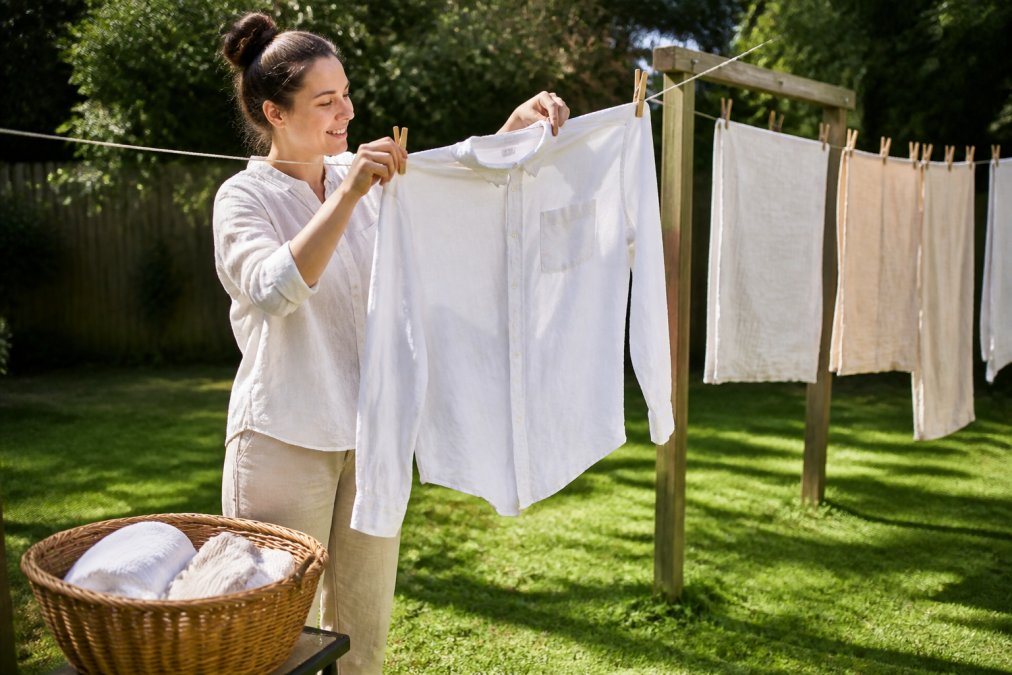
The first is relaxation shrinkage. Cotton, wool, and other natural fibers are stretched under tension during manufacturing. When they meet heat and moisture in the dryer, the fibers relax back toward their natural, unstretched length. This is why a cotton tee that fit perfectly can lose a full size after one hot cycle, the fiber is not damaged, it has simply returned to its resting state. Relaxation shrinkage is largely irreversible, which is why prevention matters more than correction.
The second is felting, which is unique to animal fibers like wool and cashmere. The surface of a wool fiber is covered in microscopic scales. Heat, moisture, and mechanical agitation, exactly what a tumble dryer provides, cause those scales to interlock and mat together. The result is a garment that is simultaneously smaller, denser, and rougher. Felting is permanent; no amount of stretching or conditioning will undo it.
Synthetics fail differently. Spandex and elastane degrade under repeated heat exposure, losing elasticity and developing a stretched, baggy fit.
Repairing Shrinkage and Pilling After the Fact
Maintaining Clothing Quality After Washing: Storage and Between-Wash Care
Repair and Restoration: Small Fixes That Extend Garment Life
The three habits that preserve clothing quality longest are cold water washing, air or low-heat drying, and storing garments with airflow between wears. Everything else is refinement.
Conclusion: A Simple Routine for Garment Longevity
Frequently Asked Questions
What is the 3-3-3 rule for clothes?
The 3-3-3 rule suggests you can wear an item three times before washing if it doesn't touch your skin directly, three times for items that touch your skin lightly, and only once for items that touch your skin heavily or get soiled. This reduces over-washing, which is a major cause of fiber breakdown and color fading. For example, a jacket might go three wears, a shirt one to two, and socks just once.
Does washing clothes inside out actually help preserve fabric?
Yes. Turning garments inside out reduces mechanical agitation on the outer surface, which helps prevent pilling, fading, and fiber breakdown. It also protects any prints or embellishments. For best results, zip zippers and button buttons to avoid snags. This simple step can significantly extend garment longevity, especially for high-quality fabrics.
How does water temperature affect the longevity of clothing?
Hot water can cause shrinkage, fade dyes, and weaken fibers over time, while cold water is gentler and helps maintain fabric integrity. For most fabrics, a cold water wash on a delicate cycle is the safest choice to prevent color bleeding and heat damage.
Is air drying always better than machine drying for garment quality?
Air drying is generally better because it avoids heat damage and mechanical agitation that can cause shrinkage and fiber breakdown. However, some fabrics like towels may feel stiff. If you must use a dryer, choose low heat and remove items slightly damp. The 2026 National Laundry Day survey found that 29% of people dry on a clothesline or rack, a practice that supports garment longevity.


