
October 30, 2026
Are Versatile Workwear Jackets Worth It for Weekend Wear?
Last Updated: October 29, 2026
Quick Summary
Versatile workwear jackets are worth it for weekend wear because their tough fabrics, generous pockets and boxy fit make them durable, functional and quietly stylish. A mid-weight canvas chore jacket is the single most versatile piece, layering over a tee in spring and a sweater when temperatures drop.
- The global workwear market is projected to reach $20.0 billion in 2026, up from $19.2 billion in 2025.
- The three families that matter most for weekend wear are chore, field and aviator jackets.
- A mid-weight cotton canvas shell of 10 to 12 ounces handles dry cold, light wind and mild drizzle.
- Keep the bottom half trimmer than a boxy jacket, with straight jeans or tapered trousers.
- Never machine-dry waxed cotton or leather, since heat sets creases and shrinks cotton canvas.
Table of Contents
- Why Workwear Jackets Fit Weekend Wear So Well
- Workwear Jackets for Men: The Styles Worth Knowing
- Fabric, Shell, and Construction: What Actually Lasts
- How to Style a Workwear Jacket Beyond the Jobsite
- The Best Work Jacket for Layering Through Temperature Swings
- Fit, Sizing, and Care for the Long Haul
- Choosing Your Next Weekend Workwear Jacket
- Frequently Asked Questions
Why Workwear Jackets Fit Weekend Wear So Well
A workwear jacket is a garment built for labor but cut for real life, and that dual purpose is why it slides so easily into a Saturday. The global workwear market is projected to reach $20.0 billion in 2026, up from $19.2 billion in 2025, according to Grand View Research's workwear market analysis.
Most style guides treat workwear as a jobsite-only look. At XEDITION77, we focus on apparel that suits a relaxed, laid-back lifestyle, from a morning errand to an afternoon with friends.
Workwear jackets are outerwear borrowed from trades and utility clothing, defined by tough fabrics, generous pockets, and a boxy fit built for movement.
Below, we break down the styles worth knowing, what actually lasts, and how to layer through a day that starts cold and ends mild.
Workwear Jackets for Men: The Styles Worth Knowing
The three families that matter most for weekend wear are chore, field, and aviator jackets. Each has a distinct personality, and knowing the difference keeps you from buying the wrong one.
Chore and Utility Jackets
The chore jacket is the workhorse: button front, boxy fit, long sleeves, and a stack of patch pockets across the chest and hips. That cargo-style layout, designed for carrying tools, is exactly what makes it useful on a weekend. Utility jackets are close cousins, often with a zip front, stand collar, or drawstring waist. Cotton canvas and cotton twill are the classic shells.
Field and Aviator Jackets
The field jacket brings military heritage: a four-pocket front, slightly longer cut, and often a plaid or olive shell. It handles wind and light rain better than a chore jacket, making it the better pick for a commute or a sketchy forecast. The aviator jacket is the warmer, more rugged option, traditionally leather or heavy cotton with a fleece lining and zip front.
| Style | Best For | Key Features | Warmth |
|---|---|---|---|
| Chore jacket | Everyday weekend wear | Button front, patch pockets, boxy fit | Light to mid |
| Utility jacket | Commute and errands | Zip front, stand collar, cargo pockets | Light |
| Field jacket | Wind and light rain | Four pockets, longer cut, plaid or olive | Mid |
| Aviator jacket | Cold mornings | Fleece lining, zip front, rugged shell | Warm |
Fabric, Shell, and Construction: What Actually Lasts
Durability comes down to three things: the outer shell, the stitching, and the hardware. Canvas and cotton are the workhorses, dense and abrasion-resistant, while polyester blends add water resistance and cut weight. A fleece lining or quilted insulation handles warmth without bulk. But "canvas or cotton" is not a buying decision; the shell should follow from the weather you actually face and the weight you are willing to carry.
Shell comparison by weather and use case
| Shell | Weight | Weather it handles | Best jacket type | Trade-off |
|---|---|---|---|---|
| Mid-weight cotton canvas (10-12 oz) | Mid | Dry cold, light wind, mild drizzle | Chore, utility | Soaks through in steady rain; needs re-waxing or a DWR finish |
| Cotton twill | Light to mid | Mild days, layering | Chore, utility | Less abrasion resistance than canvas |
| Waxed cotton | Mid to heavy | Rain and wind | Field, chore | Requires re-waxing; can feel stiff and transfer wax to light layers |
| Nylon or polyester shell with DWR | Light | Rain and wind | Utility, field | Less breathable; can read technical rather than workwear |
| Heavy cotton with fleece lining | Heavy | Cold, dry | Aviator | Too warm for swing seasons; slow to dry |
| Leather | Heavy | Cold, wind, light rain | Aviator | Highest cost; needs conditioning and spot cleaning |
Buyers tend to over-index on warmth and under-index on weather. If your weekends are mostly dry and cold, a mid-weight canvas chore jacket plus a sweater covers more days than a heavy aviator. If you live somewhere with frequent drizzle, a waxed cotton or DWR-treated shell earns its keep, because a soaked canvas jacket is heavy and slow to dry.
Construction signals worth checking before you buy
Reinforced stress points at the shoulders and pocket corners, metal rather than plastic zips, and bar-tacked buttons are the quiet signals of a jacket that survives years of wear. A common mistake is chasing a soft, broken-in feel at the expense of density; a flimsy cotton shell feels great on day one and sags by month six.
- Stitching: Look for tight, even stitching at the shoulder seam and pocket corners. Loose or single-row stitching at stress points is the first thing to fail.
- Zippers and hardware: Metal zips and riveted buttons outlast plastic and sewn-through buttons. Check that the zip runs smoothly with the jacket on a hanger, not just in your hand.
- Lining: A full lining adds structure and warmth but reduces breathability. An unlined or half-lined chore jacket layers better in spring.
Care and repair for long-term value
Care keeps a good jacket in rotation for years. Wash canvas and cotton sparingly and cold, and air dry to protect the shape. Spot clean leather and heavy shells rather than machine washing. Store on a wide hanger so the shoulders keep their form. Watch out: drying a cotton canvas jacket on high heat can shrink the shell and warp the fit, so always check the care label before the first wash.
A few habits extend life further:
- Repair before replacing. A blown seam or worn pocket corner is often a simple fix at a tailor or with a home sewing kit. Fixing stress points early is a practical maintenance habit.
- Rotate jackets rather than wearing one every day, so the shell and lining have time to dry and recover.
How to Style a Workwear Jacket Beyond the Jobsite
Styling a workwear jacket is about contrast: keep the rest of the outfit clean so the rugged shell does the talking. The difference between a jacket that looks intentional and one that looks borrowed comes down to proportion, not product.
The proportion rule that fixes most outfits
A boxy jacket adds visual width at the torso, so the rest of the outfit has to balance it. The reliable formula is a trimmer bottom half: straight or slim-straight jeans, chinos with a clean leg line, or a tapered trouser. Avoid wide-leg or baggy bottoms under a boxy shell unless you want a full workwear silhouette, because two wide shapes stack into a shapeless block.
Outfit formulas by body type
- Tall and lean: You can carry the longest field jacket and boxiest chore coat. Use a slightly longer hem and fuller pocket layout to add visual weight, paired with a straight-leg jean so the silhouette does not read as narrow top-to-bottom.
- Broad shoulders or barrel chest: Choose a chore or utility jacket with a defined shoulder seam and a hem at the hip. Skip dropped-shoulder cuts, which add width where you already have it. A zip-front utility jacket lets you wear it open to break up the chest line.
- Shorter frame: Keep the hem at the hip bone or above and avoid long field coats that cut you off at mid-thigh. A cropped chore jacket over a monochrome base (dark tee, dark jeans) extends the leg line. Roll sleeves once to keep the forearm visible.
Three weekend looks, built from the same jacket
A mid-weight canvas chore jacket in navy or olive is the test case, because it is the piece most readers will own first.
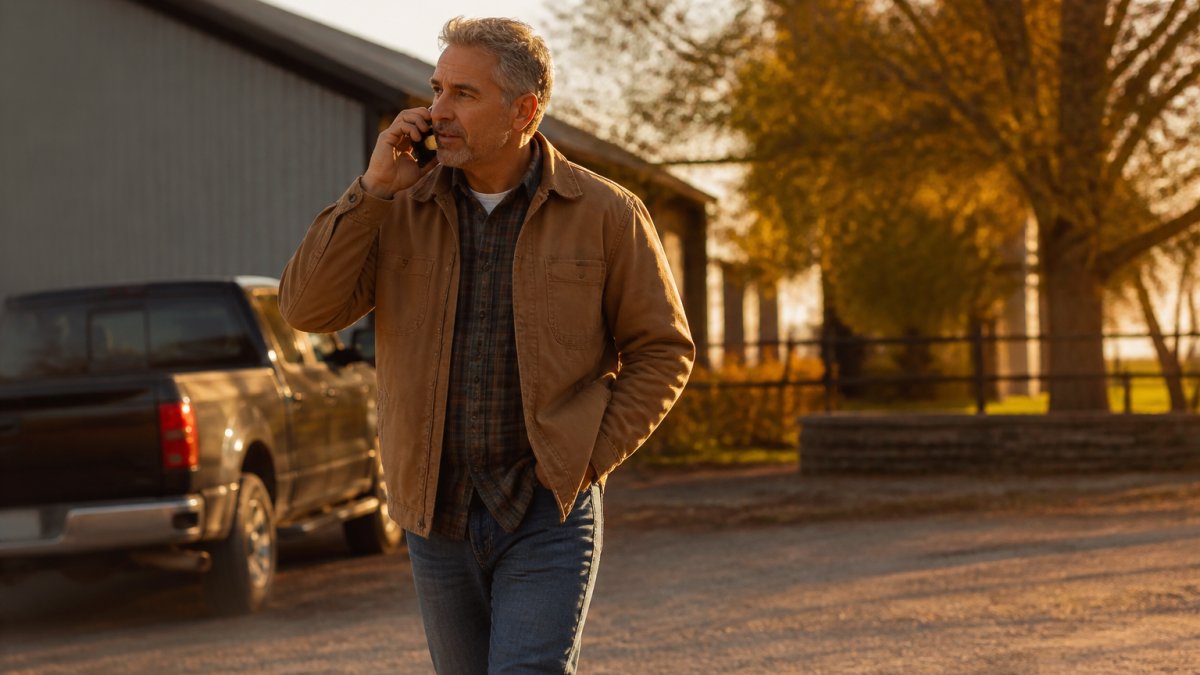
- Saturday errands: Chore jacket over a plain white or heather-gray tee, dark straight jeans, and a low-profile sneaker or chukka boot. Keep the jacket unbuttoned so the tee reads as the focal layer.
- Afternoon with friends: Swap the tee for a light oxford or fine-gauge crewneck, add khaki or stone chinos, and keep the same jacket. The collar and cleaner trouser move the outfit from errand to social without changing the shell.
- Cool-evening dinner: Layer a flannel or merino crewneck under the chore jacket, add dark denim and a leather boot, and button the jacket. The same piece now reads as a deliberate outfit rather than a thrown-on layer.
Field and aviator jackets need different styling
A field jacket in olive already carries military structure, so keep the rest simple: a crewneck and chinos, or a henley and dark jeans. Do not stack it over another utility piece, because the four-pocket front plus cargo pants reads as a costume. An aviator jacket is the boldest layer in the rotation, so let it lead: a plain tee or light sweater, dark jeans, and a simple boot.
For a more refined look, try a field jacket in olive over a crewneck and chinos. The military cut adds structure without feeling formal. Aviator jackets pair best with simple layers so the leather or heavy cotton stays the focus.
The Best Work Jacket for Layering Through Temperature Swings
The best work jacket for layering is a mid-weight canvas chore or field jacket with room to add a sweater underneath. Layering is where workwear earns its keep, because a day that starts at 45 degrees and ends at 65 demands a shell you can open, close, and shed.
Build the layers from the inside out: a base tee, a mid-layer like a flannel or light fleece, then the jacket. Choose a boxy fit so the mid-layer does not bunch at the shoulders.
Fit, Sizing, and Care for the Long Haul
Fit is where most online jacket purchases go wrong. Workwear is meant to be boxy, but boxy is not the same as oversized.
Care keeps a good jacket in rotation for years. Wash canvas and cotton sparingly and cold, and air dry to protect the shape. Spot clean leather and heavy shells rather than machine washing. Store on a wide hanger so the shoulders keep their form.
Choosing Your Next Weekend Workwear Jacket
Choosing well comes down to matching the jacket to how you actually spend your weekends. If you want one piece that does the most, start with a mid-weight canvas chore jacket in a neutral tone.
- Everyday versatility: canvas chore jacket
- Cold-weather layering: aviator with fleece lining
- Wind and light rain: field jacket
A common mistake is buying for a single occasion instead of the whole season. Buy the jacket that covers the most days, then add a second only when you have a real gap.
Frequently Asked Questions
What makes a workwear jacket suitable for weekend wear?
The jacket needs to balance durability with a clean, relaxed silhouette. Look for a boxy fit that layers over a hoodie or flannel, a cotton or canvas outer shell that softens with wear, and enough pockets for phone, keys, and wallet without looking tactical. Neutral colors like olive, tan, navy, and charcoal move easily from a garage to a coffee shop. Avoid heavy reflective striping or corporate logos, which lock the jacket to the jobsite.
Are canvas work jackets comfortable for everyday wear?
Yes, once broken in. New canvas feels stiff for the first few wears, then molds to your shoulders and elbows. A 10 to 12 ounce cotton canvas is the sweet spot for weekend wear: heavy enough to block wind, light enough to move in. Look for a fleece or flannel lining if you run cold, and check that the shoulders allow a full range of motion before you commit.
How should a workwear jacket fit over casual layers?
Size for your thickest layer, not your thinnest. A work jacket should close comfortably over a midweight hoodie or flannel with room to raise your arms overhead. The shoulder seam should sit at or just past your natural shoulder, and the hem should land around the hip bone. If you plan to wear it as your best work jacket for layering, go one size up from your t-shirt size and use the chest measurement, not the label, as your guide.
Can a work jacket be warm enough for cold-weather weekends?
It can with the right build. An unlined canvas jacket handles spring and fall on its own. For winter, choose a shell with a quilted or fleece lining, or size up to fit a sweater underneath. Layering does most of the work: a merino base layer, a flannel mid layer, and a canvas outer shell covers most cold-weather weekends without the bulk of a parka. Add a vest underneath for extra core warmth on bitter days.
The challenge is finding outerwear that works as hard as you do without looking like it. At XEDITION77, our hand-selected fabrics and timeless designs are built to entwine comfort with style, so a single jacket carries you from the garage to the weekend table. Explore our latest arrivals and find a piece that fits your rhythm. Get started with XEDITION77 and dress for every setting with quiet confidence.
