
Table of Contents
- Start With One Vintage Piece, Not a Full Look
- How to Mix Vintage and Modern Clothing for a Balanced Outfit
- Nail Proportions, Silhouettes, and Color Before You Add Layers
- Best Vintage Clothing for Men: 6 Staples Worth Owning
- Layer Vintage and Modern Pieces Without Bulk
- How to Care for Vintage Fabrics So They Last Another Decade
- How to Style Vintage Apparel for Work, Weekends, and Evenings
- Frequently Asked Questions
Last Updated: September 25, 2026
Start With One Vintage Piece, Not a Full Look
The fastest way to look like you're wearing a costume is to build an entire outfit from one era. The better approach: pick a single vintage piece and let modern clothing carry the rest of the look.
That's the core principle behind how to style vintage apparel in 2026. According to Collectif London's 2026 vintage trend report, the primary styling rule this year is mixing one vintage-era silhouette with modern basics. One piece, not five.
So if you've got a 1970s suede jacket, wear it over a plain modern tee and dark jeans. If you found a great pair of 90s straight-leg jeans, pair them with a new white button-down. The vintage piece becomes a statement piece. Everything else stays quiet.
Here's what most people get wrong: they buy a full vintage outfit, wear it once, and never touch it again. Starting with one piece keeps you in control.
How to Mix Vintage and Modern Clothing for a Balanced Outfit
A balanced outfit uses roughly 70% modern clothing and 30% vintage. This is the 70/30 rule, and it's the simplest framework for how to mix vintage and modern clothing without looking like you stepped out of a time capsule.
The 70/30 Rule: Modern Base, Vintage Accent
Your modern base does the heavy lifting. Think elevated basics: plain tees, straight-leg jeans, clean sneakers, a simple jacket.
Then add one vintage accent:
- A vintage band tee under a modern blazer
- A 70s print scarf with a plain crewneck
- Vintage denim with a new white tee
- A retro leather belt on modern chinos
Nail Proportions, Silhouettes, and Color Before You Add Layers
Get the silhouette right before you worry about accessories. Most vintage styling failures come down to proportions, not the pieces themselves.
Vintage American Flag Crewneck →
High-Waisted, Straight-Leg, and Fit-and-Flare Formulas
These three formulas work across almost every body type and era:
| Formula | Vintage Piece | Modern Pairing | Best For |
|---|---|---|---|
| High-waisted | 70s high-rise trousers | Cropped modern top | Creating leg length |
| Straight-leg | 90s straight jeans | Fitted modern tee | Everyday wear |
| Fit-and-flare | 50s-style skirt | Simple modern knit | Balanced shape |
Vintage Sizing Is Not Modern Sizing, Here's How to Work Around It
This is the part most styling guides skip, and it's the reason a lot of vintage pieces sit unworn in closets. A vintage size 12 from the 1970s is not a modern size 12. Vanity sizing has shifted women's sizes upward by roughly two to four sizes over the past fifty years, and men's suit sizing has drifted too. A 1950s size 14 might fit like a modern size 6.
- Bust or chest: Measure pit-to-pit, then double it.
- Waist: Measure across the narrowest point, then double it.
- Hips: Measure across the widest point, then double it.
- Inseam: Measure from crotch seam to hem.
- Shoulder: Measure seam-to-seam across the back.
Tailoring Vintage Safely: What You Can and Can't Change
Generally safe:
- Taking in side seams on a dress or blouse
- Hemming trousers, skirts, and sleeves
- Shortening a jacket sleeve from the cuff
- Replacing a zipper or buttons
- Adding darts for shape
Risky or impossible:
- Letting out seams, vintage garments often have narrow seam allowances, sometimes as little as 1/4 inch, leaving no fabric to release
- Resizing a lined jacket through the shoulders, which requires rebuilding the entire garment
- Altering heavily felted wool, which tears at the needle
- Changing the rise on vintage denim, which destroys the original topstitching
A common pattern among people who wear vintage well is that they buy for the shoulders and chest, then tailor everything else. Shoulders are the hardest thing to change; hems and waists are the easiest.
Best Vintage Clothing for Men: 6 Staples Worth Owning
If you're building a vintage wardrobe from scratch, start with these six pieces. Each one works with modern clothing and holds up over years of wear.
- A vintage denim jacket. Look for heavy denim and a broken-in wash.
- Straight-leg jeans from the 90s. Classic denim wash, no distressing.
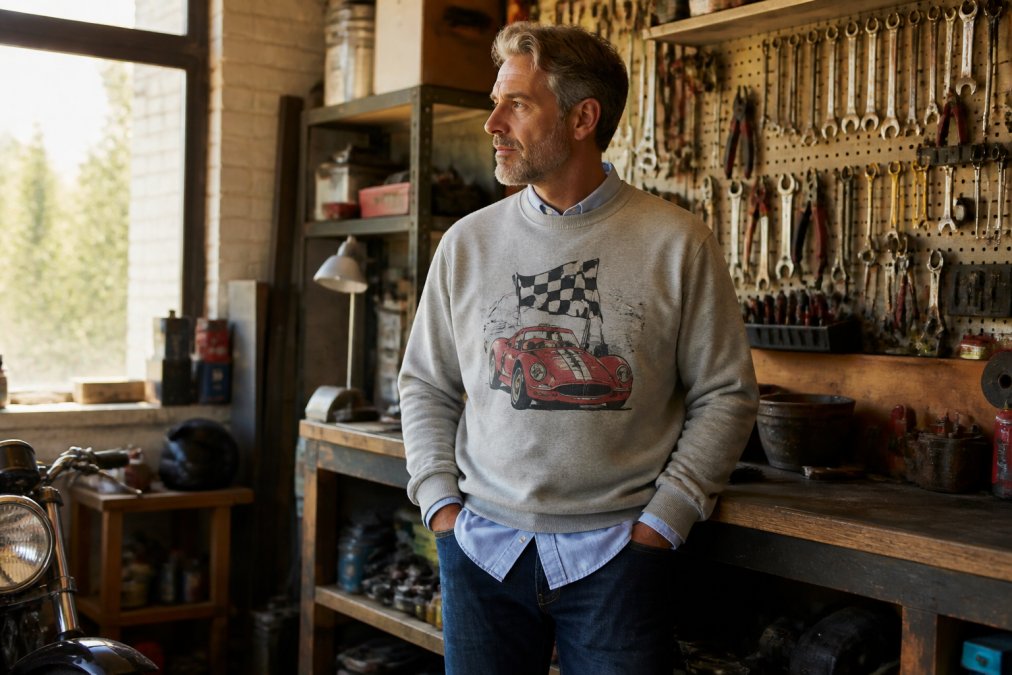
- A graphic sweatshirt or band tee. Worn-in graphics add character.
- A wool or tweed blazer. Structured shoulders, timeless style.
- A leather belt. Thick, simple hardware, no logos.
- A vintage watch or simple leather-strap timepiece. Small detail, big impact.
Layer Vintage and Modern Pieces Without Bulk
Avoid layering two vintage statement pieces. That's how you get the costume look that vintage fashion communities on Reddit warn about constantly.
How to Care for Vintage Fabrics So They Last Another Decade
Vintage fabrics need different care than new clothing. Older cotton, wool, and silk break down faster with heat, harsh detergent, and rough drying, and unlike a new garment, you can't replace a 1970s suede jacket once it's ruined. The single most important rule: cold water, low heat, and never dry clean unless the label requires it.
Vintage American Flag Crewneck →
Why Vintage Fibers Fail (and How to Slow It Down)
Natural fibers lose tensile strength as they age. Cotton oxidizes and yellows. Wool felts when heat and agitation make the scales on each fiber lock together. Silk loses luster when alkaline detergent strips its protein coating. Rayon, common in mid-century pieces, can shrink dramatically or dissolve in hot water because it's a regenerated cellulose fiber with low wet strength.
Wash, Dry, and Store by Fabric Composition
- Cotton: Machine wash cold on a gentle cycle, tumble dry low or hang dry. Skip bleach, it accelerates oxidation and yellowing.
- Wool: Hand wash cold with a pH-neutral wool wash, or dry clean. Never wring. Lay flat to dry on a towel, reshaping while damp.
- Silk: Hand wash cold with a gentle detergent made for delicates. Roll in a towel to remove water. Never wring or hang wet, silk stretches under its own weight.
- Denim: Wash inside out, cold, and hang dry to protect the indigo. Wash rarely; spot-clean between wears.
- Rayon and acetate: Hand wash cold or dry clean. These fibers have low wet strength and tear easily when soaked.
- Synthetic blends: Machine wash cold, tumble dry low. Watch for pilling on older polyester.
Store vintage pieces folded, not hung, if the fabric is delicate, hangers stress shoulder seams on aged knits and silks. Use padded hangers for structured jackets. Keep everything out of direct sunlight, which fades dye and weakens fibers over months, not years.
Mending and Repair: The Sustainable Half of Vintage Care
Most guides stop at washing. The real skill is repair, and it's what keeps a vintage piece wearable for another decade instead of another season.
- Reinforce before it tears. Check underarm seams, crotch seams on denim, and elbow patches on wool sweaters. A few minutes with a needle and matching thread now prevents a blowout later.
- Darning for knits. A wool sweater with a small hole can be darned with matching yarn using a simple woven patch technique. This is standard practice in textile conservation and is learnable in an afternoon.
- Reweaving for visible damage. For a hole in a wool blazer or a moth nibble in a silk scarf, a professional reweaver can reconstruct the missing threads. It's more expensive than replacement, but for a piece you love, it's the only option that preserves the original fabric.
- Replace buttons and zippers. Original hardware often fails before the fabric does. Save the originals in a labeled bag and swap in period-appropriate replacements.
- Address stains immediately. Blot, don't rub. Cold water for protein stains (blood, egg), diluted white vinegar for tannin stains (tea, wine), and a mild enzyme cleaner for organic residue. Test on an inside seam first.
How to Style Vintage Apparel for Work, Weekends, and Evenings
One vintage piece can shift a whole outfit's mood depending on how you build around it.
Frequently Asked Questions
How do you style vintage apparel without looking like you're in a costume?
Wear one vintage piece per outfit and anchor it with modern basics. A 2026 styling principle from Collectif London recommends mixing a single vintage-era silhouette with contemporary staples, like pairing a 1970s flowy print shirt with plain dark jeans and clean sneakers. Skip period accessories, avoid head-to-toe retro, and keep the fit modern. The goal is a vintage accent, not a full reenactment.
How can men incorporate vintage pieces into a modern wardrobe?
Start with the best vintage clothing for men: a broken-in denim jacket, a crewneck sweatshirt, a straight-leg jean, or a flannel overshirt. Wear each with modern elevated basics like plain tees, chinos, or clean white sneakers. Gen Z shoppers are pulling 1970s, 1990s, and early 2000s references in 2026, so a worn-in graphic sweatshirt over a modern tee reads current, not dated. One piece at a time keeps the look intentional.
How do you balance vintage textures with modern fabrics?
Pair one textured vintage piece with smooth modern fabrics to keep the look sharp. A heavyweight cotton-poly crewneck or a garment-dyed tee works well over crisp cotton or technical fabrics. Texture mixing works best when the vintage item is the only rough or faded element in the outfit. Keep the rest of the look clean so the vintage piece reads as a statement, not a theme.
What are the best vintage staples for a mature man's closet?
Focus on pieces that age well and fit a relaxed lifestyle: a vintage-style crewneck sweatshirt, a garment-dyed graphic tee, a straight-leg dark denim wash, a broken-in flannel, and a simple hoodie. Each works with modern basics and holds up to regular wear. Look for sturdy construction like double-needle stitching and ribbed collars. A small curated collection of 5-6 pieces beats a closet full of one-off finds.


