


Table of Contents
- Why Quality Clothing Matters More Than Ever in 2026
- How to Identify Natural vs Synthetic Fabrics
- Signs of Well-Made Clothing: A 10-Point Inspection
- Is Capsule Wardrobe Dressing Worth It?
- The Cost-Per-Wear Calculation: A Financial Framework
- Special Considerations for Second-Hand and Thrift Shopping
- Conclusion
- Frequently Asked Questions
Last Updated: September 27, 2026
Why Quality Clothing Matters More Than Ever in 2026
Consumers report wearing their clothing for nearly five years before it's considered worn out, according to the Cotton Incorporated Durability Survey 2026. That number tells you something important: how to spot quality clothing isn't a vanity skill. It's a financial one.
At XEDITION77, we've built our collection around hand-selected fabrics precisely because construction quality determines whether a garment lasts two years or ten. The stakes keep rising. Less than 1% of clothing is currently recycled into new clothing, per the Ellen MacArthur Foundation, and over $100 billion is lost annually to the lack of clothing recycling.
How to Identify Natural vs Synthetic Fabrics
"Natural" and "synthetic" are not quality labels on their own. A 100% linen shirt can be woven so loosely it tears at the armhole, and a polyester blend can outlast a cheap cotton tee by years. What matters is whether the fiber matches the job the garment is supposed to do. Here is how each common fiber actually behaves.
What Each Fiber Does Well and Poorly
- Cotton: Breathable, holds shape, takes dye well, and softens with washing. Weak points are shrinkage (expect 3-5% on an untreated cotton tee) and slow drying. Long-staple varieties like Pima and Supima resist pilling far better than short-staple upland cotton.
- Linen: The strongest common plant fiber when wet, and it gets softer every wash. It wrinkles by design, so a linen garment that claims to be wrinkle-free is usually blended with polyester or resin-treated.
- Wool: Resists odor, regulates temperature, and can absorb up to roughly 30% of its weight in moisture before feeling damp. Merino is fine and non-itchy; coarser wools are durable but scratchy. Wool shrinks and felts permanently under heat and agitation.
- Silk: Strong for its weight with a natural sheen, but it degrades with sunlight and perspiration over time. It is a poor choice for daily-wear basics.
- Polyester: Abrasion-resistant, cheap, and quick-drying, which is why it dominates activewear. Its weaknesses are odor retention and pilling when spun from short fibers. Recycled polyester behaves the same as virgin polyester; the difference is feedstock, not performance.
- Nylon: Stronger and more elastic than polyester, which is why it shows up in outerwear and hosiery. It yellows with age and UV exposure.
- Elastane (Spandex/Lycra): Adds stretch, but degrades with heat and chlorine. A garment with more than about 5% elastane tends to lose recovery and go baggy at the knees and elbows.
Reading Fiber Content Labels
Check the label before the price tag. Fiber content is listed in descending order by weight, so the first fiber named is the dominant one. A "95% cotton / 5% elastane" tee is a cotton tee with stretch; a "60% polyester / 40% cotton" tee is a plastic-forward blend wearing a cotton label.
The Hand Feel and Light Tests
Rub the fabric between your fingers. Quality cotton feels dense and slightly rough before washing, then softens. Cheap fabric feels slick or papery. Natural fibers breathe; synthetics trap heat. A quick way to separate them: synthetic knits feel cool and slightly clammy against the skin, while natural knits feel dry.
Signs of Well-Made Clothing: A 10-Point Inspection
A well-made garment shows it in ten places: seam allowance, stitch density, pattern matching, hardware, lining, hem finishing, buttonholes, zipper smoothness, interfacing, and colorfastness. Here is how to check each one in order, with the specific failure each check is designed to catch.
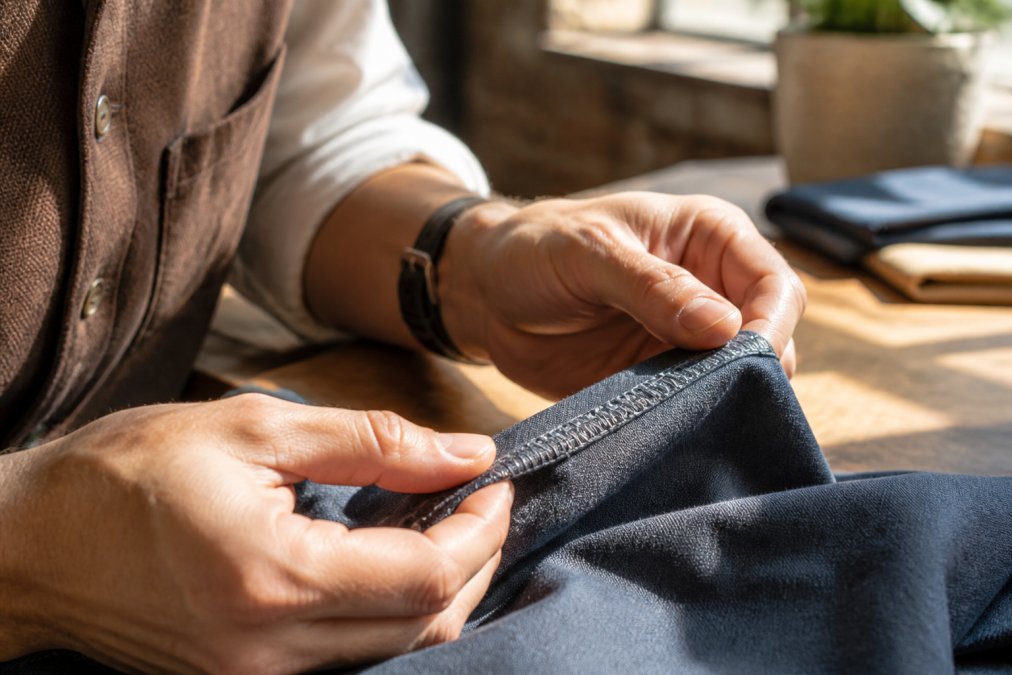
Seams, Stitching, and Pattern Matching
- Seam allowance: At least 1 cm (about 3/8 inch) of extra fabric inside the seam. Narrow allowances fray and pull apart at stress points like armholes and crotches. Turn the garment inside out and look at the raw edge.
- Stitch density: 8-12 stitches per inch on a standard seam. Sparse stitching (under 8) pulls apart under tension; overly dense stitching (over 14) can perforate the fabric and cause it to tear along the stitch line. Count the stitches over one inch with a ruler.
- Pattern matching: Stripes and plaids should align at the seams, especially at the center front, side seams, and pocket joins. Misalignment signals rushed, mass-produced construction because matching patterns wastes fabric and requires extra labor.
- Plackets and yokes: These should lie flat with no puckering. Puckering means the fabric was stretched during sewing and will distort further after washing.
- Seam type: Look for flat-felled or French seams on visible interior areas. These enclose the raw edge and resist fraying. A simple serged (overlocked) edge is acceptable on knits but a warning sign on structured wovens.
Hardware, Linings, and Finishing Details
- Buttons and buttonholes: Buttons should feel heavy and be sewn with a shank (a small thread stem) so they sit above the fabric. Buttonholes should be tightly stitched with no loose threads; a fraying buttonhole will unravel within months. Plastic buttons are fine on casual wear; horn, corozo, or metal signal a higher-end garment.
- Zippers: Test the zipper. It should glide without catching. Metal zippers (YKK is the most common quality benchmark) outlast plastic coil zippers in heavy-use garments like denim and outerwear. Check that the zipper tape is sewn straight and the pull tab is securely attached.
- Lining quality: A good lining is sewn in, not glued, and moves independently of the outer fabric. Glued linings bubble and separate after dry cleaning. Check that the lining has a pleat at the center back for movement.
- Hem finishing and interfacing: Hems should be blind-stitched or cleanly finished inside. Interfacing (the stiffener inside collars, cuffs, and plackets) should not be visible as a separate layer through the fabric. If you can feel a plastic sheet inside a collar, it will crack with age.
- Colorfastness: Rub a damp white cloth against the fabric, especially on dark or saturated colors. If dye transfers, the garment will bleed onto other clothes in the wash and fade unevenly.
Is Capsule Wardrobe Dressing Worth It?
For most people, yes. A capsule wardrobe is a small collection of versatile, high-quality pieces that mix and match, and it works because fewer, better garments reduce both decision fatigue and replacement costs.
The Cost-Per-Wear Calculation: A Financial Framework
Cost-per-wear is the purchase price divided by the number of times you wear the item. It's the single best way to judge whether clothing is actually expensive.
Garment |
Price |
Wears Per Year |
Years Worn |
Cost-Per-Wear |
|---|---|---|---|---|
Fast-fashion tee |
$12 |
15 |
1 |
$0.80 |
Mid-range tee |
$35 |
30 |
3 |
$0.39 |
Quality garment-dyed tee |
$26.58 |
40 |
5 |
$0.13 |
Special Considerations for Second-Hand and Thrift Shopping
Thrift shopping rewards the same inspection skills, plus a few extras. Feel for pilling under the arms and between the thighs first, since friction wear shows there before anywhere else. Check the bias cut and fabric drape by holding the garment up; natural fibers should fall smoothly, while tired synthetics hang stiff or limp.
Conclusion
Most shoppers waste money because they judge clothing by the tag instead of the seams, fiber content, and stitch density. Learning how to spot quality clothing flips that equation: you buy less, wear longer, and pay less per wear every year.
Frequently Asked Questions
What are the tell-tale signs of high-quality stitching?
High-quality stitching shows dense, even stitches with no loose threads or skipped stitches. Look for double-needle stitching on seams and hems, which adds durability. Seams should lie flat without puckering, and stitch density should be consistent. Pattern matching at seams, where stripes or plaids align, is another strong indicator. According to fashion experts, inspecting internal seams and fabric density is more reliable than relying on price tags or brand labels.
How can you tell if fabric will pill or lose its shape?
Pilling happens when short fibers work loose and tangle. To assess risk, check the fiber content: natural fibers like cotton are less prone to pilling than synthetic blends. Rub the fabric gently between your fingers; if loose fibers surface quickly, it may pill. For shape retention, look for a tight knit or weave and check that the garment has good tensile strength. Pre-shrunk fabrics and proper care instructions also help maintain shape after washing.
Is a higher price tag always an indicator of quality clothing?
No. Price is not a reliable indicator of quality. High-end branding does not guarantee superior construction. Experts advise inspecting internal seams, fabric density, and finishing details rather than trusting price tags or labels alone. A $200 shirt with poor stitching will not outlast a $50 shirt with double-needle seams and quality natural fibers. Focus on construction and material, not the logo.
What is the cost-per-wear calculation and why does it matter?
Cost-per-wear divides the purchase price by the number of times you expect to wear the item. A $100 jacket worn 100 times costs $1 per wear; a $30 jacket worn 10 times costs $3 per wear. This framework reveals the true value of a garment. Buying durable pieces that last reduces waste and saves money over time.
XEDITION77 builds apparel for people who want exactly that. Our pieces use hand-selected fabrics, heavyweight 6.1 oz ring-spun cotton, and double-needle construction, with timeless 'Mr. Blunt' themed designs made to be worn for years rather than seasons. Explore our latest arrivals and find clothing that earns its place in your rotation. Shop now →


