


Table of Contents
- Why Men Are Moving On From Industrie
- Price-Point Comparison: What You Actually Pay
- How to Build a Capsule Wardrobe for Men With Better Basics
- Sustainable Men's Clothing Brands: How to Vet Real Claims
- Best Alternatives to Industrie for Men: XEDITION77 Picks
- Fit, Fabric, and Regional Availability: What to Check Before You Buy
- Frequently Asked Questions
Last Updated: September 13, 2026
Why Men Are Moving On From Industrie
The men's basics market has shifted, and the shift is measurable. Baymard Institute's 2025 Apparel & Accessories UX Benchmark, which analyzed 7,000+ UX performance scores across 14 apparel and accessories sites, found that shoppers judge fabric and fit long before they judge the brand name on the label. That finding tracks with what men are actually complaining about: thinner fabrics, inconsistent sizing, and basics that lose their shape after a season.
If you're searching for the best alternatives to Industrie for men, the category has fragmented. At XEDITION77, we've watched guys in their 30s through 50s stop chasing trend cycles: they want heavyweight cotton, a fit that respects a working body, and a shirt that still looks right two years in.
Below: what changed, what you should pay, and which pieces earn a spot in a smaller, better wardrobe.
Fabric Weight and Durability: What Changed
Fabric weight is the clearest difference between a tee that survives a year and one that doesn't. A 6.1 oz garment-dyed cotton tee holds structure through repeated washing; a 4.2 oz shirt feels lighter on day one and noticeably thinner by month six.
Most complaints about contemporary menswear trace back to fabric weight and construction, not design. Double-needle stitching at the seams, tubular knit construction, and pre-shrunk cotton all affect how a shirt ages. Somnad Lab's 2026 analysis of high-quality basic clothing notes that brands refining the same core pieces year after year, rather than chasing seasonal drops, tend to hold up better in the wash.
Fit and Sizing Complaints
Fit is where mass-market basics lose most customers. The grievances are consistent: shoulders that pull, hems that ride up, and a "slim fit" that's really just a size down.
A relaxed, boxy cut with dropped shoulders accommodates a broader frame without looking oversized. Retail-fit tees with side seams and shoulder tape retain their silhouette better than tubular cuts when you're moving around on a job site. Know your width and length in inches before ordering.
Price-Point Comparison: What You Actually Pay
Price is the question men ask first, and the answer is more interesting than "cheaper is better." Cost-per-wear, not sticker price, is the metric that matters: a $26 tee worn 80 times costs about 33 cents per wear, while a $15 tee that pills by month four costs more per outing.
Here's what XEDITION77's core basics cost against the value they deliver.
| Piece | Price | Fabric Weight | Best For |
|---|---|---|---|
| MR.BLUNT Pocket Flag Tee | $22.98 | 4.2 oz Airlume cotton | Everyday wear, layering |
| Vintage Flag Tee (distressed) | $26.58 | 6.1 oz ring-spun cotton | Work and weekend rotation |
| Rick's Crabs Coastal Tee | $26.58 | 6.1 oz ring-spun cotton | Casual, relaxed settings |
| Flag Pocket Tee (boxy fit) | $28.83 | 6.0 oz combed cotton | Broader frames, relaxed fit |
| American F#*k Around Tee | $33.99 | 6.1 oz garment-dyed cotton | Statement pieces, cookouts |
| Patriotic Hoodie | $35.18 | 8.0 oz cotton-poly blend | Cooler months, layering |
| Crewneck Sweatshirt | $36.55 | 8.0 oz cotton-poly blend | Mid-weight layering |
That $22.98 to $36.55 band covers a full rotation of tees, hoodies, and sweatshirts. Compare that against replacing a thin $18 tee three times a year and the math stops being close.

How to Build a Capsule Wardrobe for Men With Better Basics
A capsule wardrobe for men is a small, fixed set of garments that mix freely, so getting dressed takes seconds instead of deliberation. The goal isn't minimalism for its own sake, it's a rotation where every piece earns its space, with each slot's fabric weight and fit profile chosen on purpose.
Most capsule guides stop at "buy ten things." The hard part is matching each slot to a fabric weight and fit profile that works for your frame and your week. Here's the framework we use, with specs attached.
The 10-Piece Starter Framework (With Specs)
- Four heavyweight tees, two solid, two graphic. Target 6.0-6.1 oz ring-spun or garment-dyed cotton. This is the workhorse slot; anything under 5.5 oz will thin out by month six.
- One boxy-fit tee, 6.0 oz combed cotton with dropped shoulders. Reserve this for days you want a looser drape over a broader frame.
- Two mid-weight crewneck sweatshirts, 8.0 oz cotton-poly blend, ribbed collar, soft inner fleece. These layer over tees without adding bulk.
- One heavyweight hoodie, 8.0 oz brushed blend, double-lined hood, kangaroo pocket. Cold mornings and evening bonfires.
- Two pairs of well-fitted denim or canvas trousers, one dark, one washed. Match the rise to your torso length, not the trend cycle.
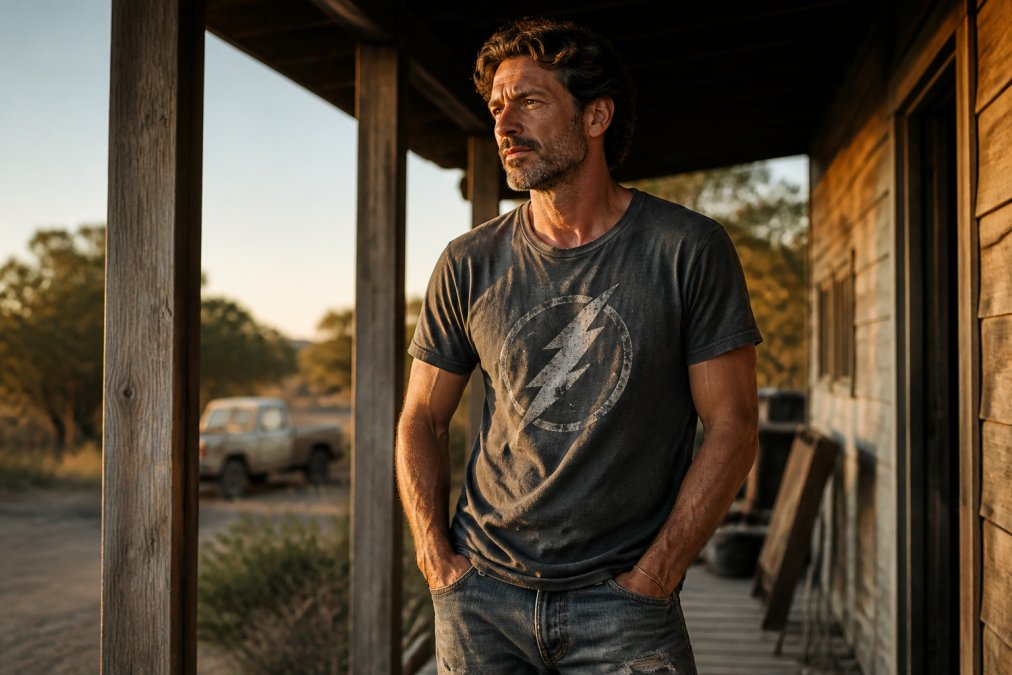
Fit Profiles: Pick the Cut Before the Color
Fit is the reason most men switch brands, and the spec most capsule guides skip. Before you buy, decide which of these three profiles matches your body and your week:
- Relaxed / boxy, dropped shoulders, wider chest, straight hem. Best for broader frames and guys who move around on a job site. Look for side seams and shoulder tape; tubular cuts lose their silhouette faster when you're active.
- Retail / classic, trimmer through the chest, standard shoulder, hem sits at mid-hip. The safest layering cut under a flannel or jacket.
- Athletic / tapered, fitted through the chest and waist, roomier through the shoulders. Hardest to find off the rack; measure your chest width in inches and compare to the product's width chart before ordering.
Men often buy one profile across every slot and then wonder why half the wardrobe feels wrong. Mix profiles on purpose: a boxy tee over tapered trousers reads intentional; a boxy tee over boxy trousers reads shapeless.
Cost-Per-Wear: The Math That Justifies the Upgrade
Cost-per-wear, not sticker price, decides whether a capsule actually saves money. A $26 heavyweight tee worn 80 times costs about 33 cents per wear. A $15 lightweight tee that pills by month four and gets replaced three times a year costs roughly the same per wear, but you spent three shopping trips and three returns to get there.
Run the math on your own rotation before you buy. If a piece won't clear 40 wears, it doesn't belong in a capsule.
Sustainable Men's Clothing Brands: How to Vet Real Claims
"Sustainable" is the most abused word in menswear, and many brand lists are driven by affiliate commissions rather than actual vetting. Treat the label as a claim to verify, not a fact to trust.
The Ellen MacArthur Foundation's 2026 work on circular economy principles in fashion supply chains frames the real standard: how a garment is made, how long it lasts, and what happens to it at end of life. Durability is the most honest sustainability metric there is, a shirt you wear for three years displaces three shirts you would have replaced.
Certifications That Actually Mean Something
- OEKO-TEX STANDARD 100: tests finished textiles for harmful substances at the fiber, yarn, and finished-garment stages. It does not certify that the cotton was grown responsibly, only that the finished fabric passed chemical limits.
- REACH certification: confirms compliance with chemical safety standards for the European market. Useful as a floor, not a ceiling; it doesn't speak to labor practices.
- Ethically sourced US cotton: traceable fiber origin, not a vague "eco" badge. Ask for the grower or cooperative name if the brand claims it.
- GOTS (Global Organic Textile Standard): covers organic fiber content plus processing and social criteria. Stricter than OEKO-TEX alone, and rarer on mid-range menswear.
How to Read a Fabric Spec for Durability
The most useful sustainability signal on a product page isn't a green logo, it's the fabric weight and construction notes. A 6.1 oz garment-dyed cotton tee with double-needle seams and tubular knit construction will outlast a 4.2 oz tee with single-stitch seams by a wide margin, whatever either label claims.
Look for three specs in this order:
- Fabric weight in ounces, under 5.5 oz is a lightweight tee; 6.0 oz and up is where durability lives.
- Fiber content, 100% ring-spun cotton ages differently than a 50/50 blend. Neither is inherently better; they just fail in different ways.
- Construction details, double-needle stitching at stress seams, shoulder tape, and side seams (versus tubular knit) all affect how a shirt holds shape through wash cycles.
If a product page lists none of these, treat the sustainability claim as unverified. A brand that won't publish fabric weight is unlikely to publish its supply chain.
Greenwashing Red Flags
A few patterns show up again and again on mid-range menswear sites:
- A "sustainable collection" that's a small subset of the catalog, with no explanation of what makes it different.
- Carbon-neutral shipping claims that offset delivery but say nothing about how the garment was made.
- Recycled packaging highlighted as the headline sustainability feature, packaging is a rounding error next to fiber and labor.
- No named factory, no named mill, no named certification body.
Best Alternatives to Industrie for Men: XEDITION77 Picks
The best alternatives to Industrie for men solve the two problems driving guys away: thin fabric and inconsistent fit. XEDITION77 builds around heavyweight, garment-dyed cotton with a relaxed cut that suits a working frame, and the catalog below reflects that focus.
Our top pick is the Xedition 77 Vintage Flag Tee at $26.58. It's 100% ring-spun US cotton at 6.1 oz, garment-dyed after construction for a broken-in drape. The one drawback: garment-dyed cotton fades over time by design, so if you want a shirt that stays jet black, this isn't it.
Heavyweight Tees That Hold Their Shape
For a bolder statement, the American F#*k Around And Find Out Tee at $33.99 carries the same 6.1 oz garment-dyed construction with a distressed stencil print and weathered flag back. It runs S-4XL and holds its shape through wear and wash.

If you want something quieter, the MR.BLUNT Pocket Flag Tee at $22.98 is the entry point: lightweight 4.2 oz Airlume cotton, a small chest print, and a retail fit that layers cleanly under a flannel. Best for warm-weather wear and guys who don't want a loud graphic.
For a roomier cut, the MR.BLUNT American Flag Pocket Tee at $28.83 uses a 6.0 oz combed cotton body with dropped shoulders and a boxy silhouette. The Rick's Crabs Coastal Tee at $26.58 matches the 6.1 oz weight with a sun-bleached coastal back print for a slower, water-side look.

Layering Pieces for Cooler Months
Cold-weather layering is where the 8.0 oz pieces earn their keep. The Patriotic Hoodie at $35.18 uses a brushed 50/50 cotton-poly blend with a double-lined hood and kangaroo pocket.
The Crewneck Sweatshirt at $44.99 brings the same 8.0 oz weight with a classic ribbed collar. For something with more character, the Blunt Way of Life Crewneck at $36.55 carries a full-color back print and sleeve panel graphics.
Fit, Fabric, and Regional Availability: What to Check Before You Buy
Three checks separate a good purchase from a return: fabric composition, fit profile, and shipping terms. Get those right and ordering online stops being a gamble.
Fabric composition should be listed by weight and fiber content. A "100% ring-spun cotton, 6.1 oz" spec tells you more than any marketing copy. Fit profile matters more than size letter: measure a shirt you already own across the chest and compare it to the product's width chart in inches. Shipping and returns vary by region, so confirm delivery windows and the return policy before checkout, especially if sizing is uncertain.
Ape to Gentleman's 2026 guide to lesser-known menswear labels makes the same point from a different angle: the brands worth your money are the ones publishing real specifications rather than lifestyle photography alone.
Finding basics that survive more than a season shouldn't require guesswork or entry-level luxury prices for a shirt that thins out by spring. XEDITION77 builds around hand-selected fabrics, heavyweight garment-dyed cotton, and a relaxed fit that works whether you're on a job site or on the porch. Start with the Vintage Flag Tee, add a mid-weight crewneck for layering, and build the rotation from there. Shop now and see what a wardrobe of fewer, better pieces actually feels like.
Frequently Asked Questions
Is Industrie clothing actually good quality?
Quality perception varies. Some shoppers report that standard contemporary menswear brands use thinner fabrics and repetitive designs. The best way to judge is to check fabric weight in ounces per square yard, look for double-needle stitching, and read reviews that mention durability after repeated washes. Heavier fabrics (6 oz and up for tees) generally hold shape longer than lightweight alternatives.
What should I look for when choosing a sustainable men's clothing brand?
Look for third-party certifications rather than marketing language. OEKO-TEX STANDARD 100 confirms dyes and finishes meet safety standards. REACH certification covers chemical compliance. Also check whether the brand discloses its supply chain, names its manufacturing partners, and uses permanent collections instead of constant seasonal drops. A 2026 analysis by Somnad Lab noted brands refine the same core pieces year after year rather than following fast-fashion cycles.
Where do men over 40 find high-quality timeless wardrobe staples?
Focus on fabric weight, construction details, and fit profile rather than brand names. Look for heavyweight ring-spun cotton, garment-dyed finishes that age well, and relaxed or classic fits that do not cling. A capsule approach works well: build around 8-10 core pieces in neutral colors. The Good Trade's 2026 sustainable menswear list highlighted brands for quality basics that work for mature buyers.
How do I build a capsule wardrobe for men without overspending?
Start with 10 pieces: 3-4 tees in neutral tones, 2 button-ups, 1 pair of dark denim, 1 pair of chinos, 1 layering piece (hoodie or crewneck), and 1 pair of boots. Choose heavier fabrics where possible. Garment-dyed tees at $26-$40 often outperform cheaper alternatives on cost-per-wear because they keep their shape and color longer. Replace items only when they wear out, not when trends shift.
Is it worth investing in premium men's apparel brands?
It depends on cost-per-wear. A $40 heavyweight tee worn twice a week for two years costs roughly $0.38 per wear. A $15 lightweight tee that loses shape after six months costs more per wear. Premium basics make sense when the fabric weight, stitching, and fit justify the price. Check the return policy before ordering, and look for brands that offer a warranty or guarantee on construction.


